A Polymarket price reads directly as a probability, and most gaps between that price and your own number fall apart once you check them. They turn out to be thin order books, ambiguous resolution wording, or news that was priced before you saw it.
We worked through one live market to show the check: "Will the Los Angeles Dodgers win the 2026 National League Championship Series?", listed on the Polymarket market page. Every number below was pulled from Polymarket's public API on 14 October 2026, and anyone can reproduce it.
The check runs in five steps. Convert the quote into an implied probability using the best ask rather than the last trade. Set your own fair value before you look at the market price. Convert the gap into expected value net of the spread and the overround. Rule out the three gaps that are not real. A gap that clears all of that still has to be watched, because prediction-market prices converge as the resolution date approaches, so the finding goes stale and the remaining work is monitoring.
What "mispriced" means on Polymarket
A prediction market outcome is mispriced when the price a trader can actually transact at, after fees and the bid-ask spread, differs from the probability that the available evidence supports.
A quote of 31¢ on a YES share means the market prices the event at roughly 31%, but that 31¢ is one resting order. Whether the price holds for the size you want to trade is a separate question, and it is the question that kills most edges.
Two facts matter before any arithmetic. Under Polymarket's payout rules, a share pays $1 if the outcome resolves YES and $0 otherwise, so the price in cents reads directly as a percentage: a 31¢ YES share is a 31% implied probability. And YES and NO on the same outcome should sum to $1, though in live order books they usually sum to slightly more. That excess is the cost of using the market, and it comes out of your edge first.
Why most edges are not edges
The feeling of finding an edge is almost entirely uncorrelated with having one.
You read something the market appears not to have priced. You look at the odds, and they seem wrong. Someone who is well informed feels that, and so does the last person to learn the news; from the inside the two are indistinguishable. So the check below runs in order, and its job is to find the specific reason you are wrong. The gap only counts when you fail to find one.
A second failure mode is harder to notice. Gaps cluster at the extremes, on outcomes priced at 3¢ or 96¢, and people take that clustering as evidence that the tails are where the money is. More often it means your model is unreliable in the tails. Getting a 50/50 event to 55% is ordinary work. Claiming that a 3¢ market should be 6¢ is claiming to have doubled a probability that a lot of people have already looked at.
The five-step check
Step 1. Translate the quote into a probability you could actually pay
Use the best ask, not the last traded price. The last trade tells you where someone else transacted, possibly hours ago, possibly for $40.
Then add both sides. On the Dodgers market the best ask was 31¢ on YES and 70¢ on NO. The pair sums to 101¢.
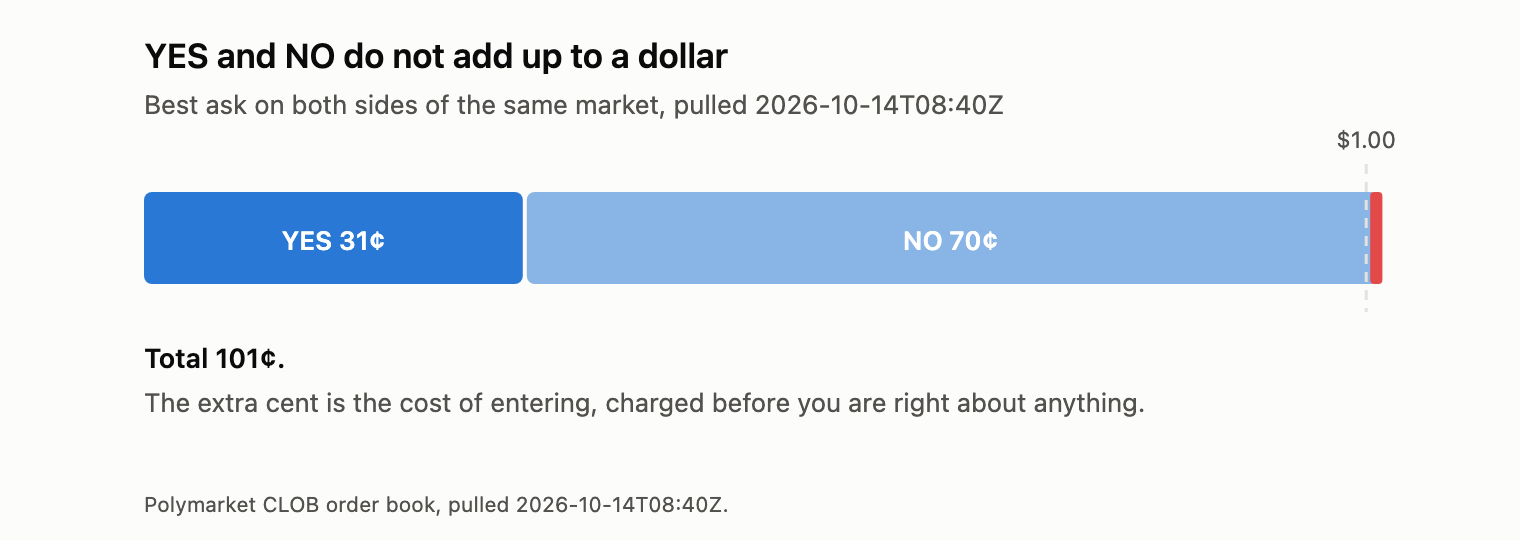
That one-cent overround is the friction you pay for entering, and it applies before you are right about anything.
Write down the number you could actually pay and use it as the market's probability for the rest of the check. The large price on the page is the bid-ask midpoint, and the last trade may be stale; neither is a price you can get.
Step 2. Set your own fair value before you look at the price
The order is deliberate. If you look at 31¢ first and then reason toward your own estimate, you will land somewhere near 31¢ and feel that you got there independently. Knowing about anchoring does not stop it.
So state the base rate for this class of event, list the conditions that would move it away from the base rate, assign a number, and write it down. Most people skip the writing. An estimate you did not record is one you will quietly revise once you see the price, without noticing.
Step 3. Convert the gap into expected value
Calling a price "cheap" does not tell you what it is worth. The same gap in percentage points is worth very different amounts depending on where it sits on the curve.
| Your fair value | Best ask | Gap | Cost per $1 of payout | Expected value per share |
|---|---|---|---|---|
| 55% | 50¢ | 5 pts | 50¢ | +5.0¢ |
| 20% | 15¢ | 5 pts | 15¢ | +5.0¢ |
| 8% | 3¢ | 5 pts | 3¢ | +5.0¢ |
Illustrative arithmetic. Expected value shown before spread, fees and the overround from Step 1.
The raw expected value is identical across the three rows, and the risk is not. The third row requires you to be right about a probability that is difficult to estimate at all, and a one-point error in your model wipes out the whole rationale for the position.
Subtract the overround and the spread from Step 1 before you decide anything. A five-cent edge with a three-cent round trip is a two-cent edge.
Step 4. Rule out the three fake gaps
This is where most candidates die. Run all three, in this order, and stop at the first hit.
| Fake gap | What it looks like | How to test it |
|---|---|---|
| Thin liquidity | The mispriced quote is real but it is only good for a small size. The rest of your order fills higher. | Look at the depth on the side you want, not the top-of-book quote. Compute your average fill price at the size you would actually trade. |
| Ambiguous resolution | You and the market are pricing two different questions. | Read the resolution criteria in full. Establish the settlement source, the timezone, the cutoff moment, and what an edge case resolves to. Disagreements about wording show up as price gaps. |
| Already-priced information | The news you are trading on is public, and the price moved before you got there. | Check when the price moved relative to when the information became public. If the move precedes your discovery of it, you are not early. |
Most traders assume their size is too small for thin liquidity to matter, so we measured it. The Dodgers market had roughly $1.0 million of resting liquidity, which puts it among the deeper books on the platform. The first 5,000 shares still fill at the 31.00¢ quote. Twenty thousand shares average 31.63¢. Four hundred thousand average 32.73¢.
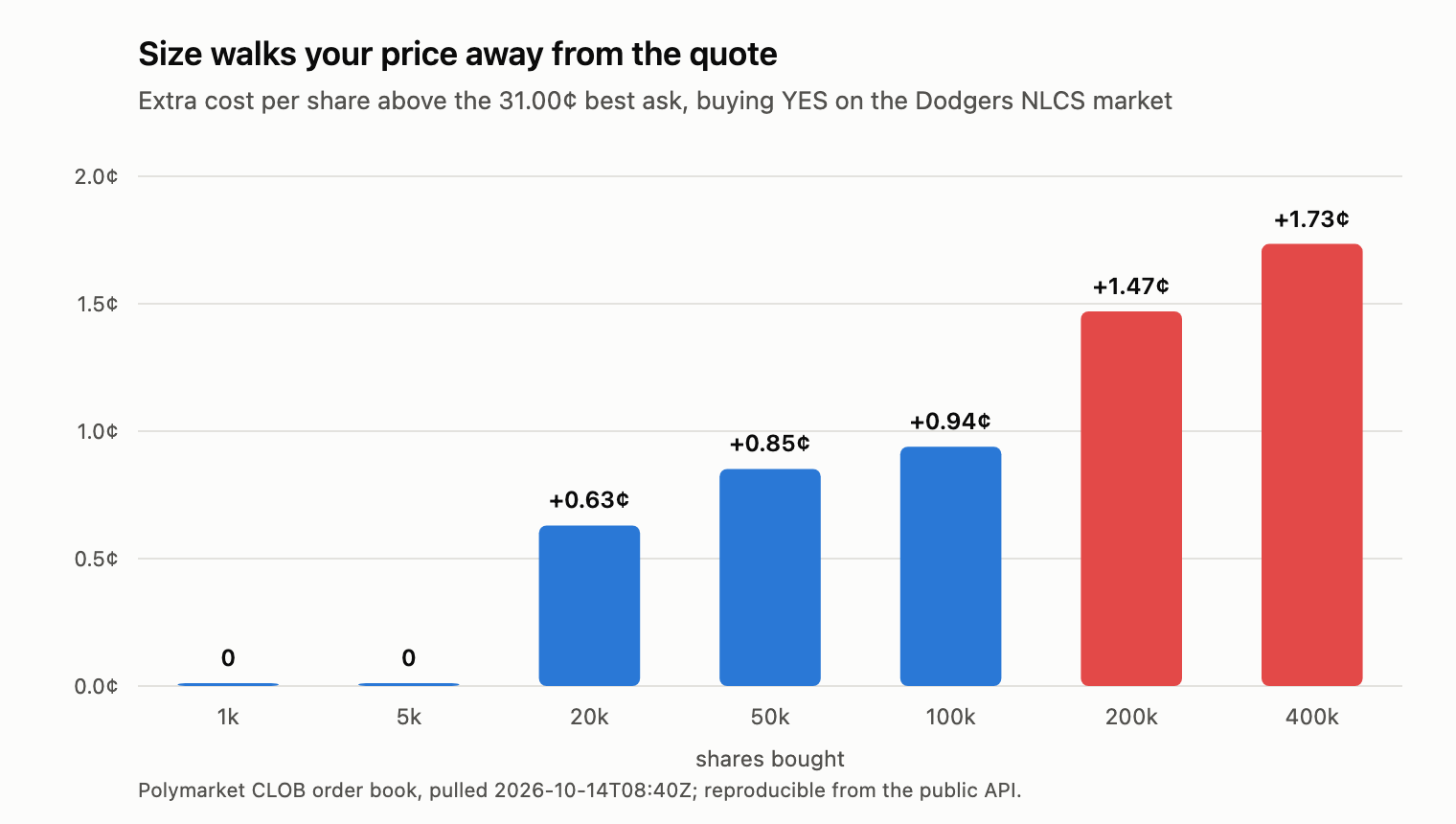
If you thought you had a five-cent edge and wanted four hundred thousand shares, 1.73¢ of it went to the order book before the event resolved. The edge was 3.27¢, minus the overround from Step 1.
On resolution: a large share of apparent mispricing on event markets comes from two sides reading the resolution rules differently. Two people can hold identical views about what will happen and correctly trade against each other, because one is pricing "announced by" and the other is pricing "completed by." Polymarket resolves markets through the UMA Optimistic Oracle against that text, and its documentation tells traders to read the rules before trading.
Step 5. Treat a surviving gap as a monitoring assignment
A gap that clears Steps 1 through 4 is worth considering, and it is perishable.
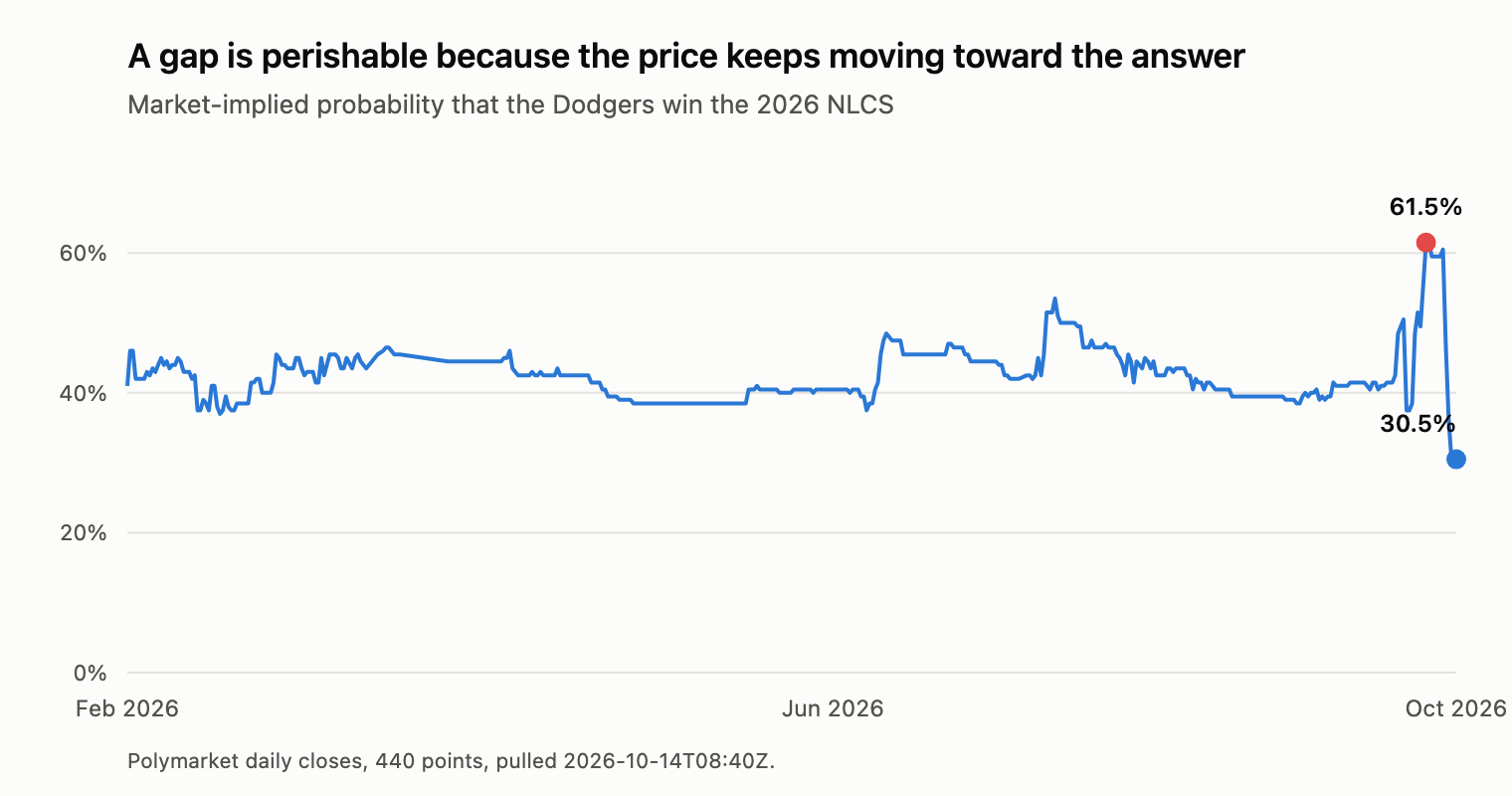
The same Dodgers market spent eight months between roughly 30% and 45%, touched 61.5%, and sat at 30.5% when this was written.
Prediction-market prices converge toward the eventual outcome as the resolution date approaches and as information arrives. That convergence pays whoever was right, and it also closes your entry window. The gap you found at 2 a.m. can be gone by the time you finish checking it, because someone else finished first.
The constraint, then, is time. Finding a gap is work you can do once, carefully, when you have an hour. Staying on top of it is a duration problem, and a person cannot hold a 24/7 market in continuous attention. The evidence that changes your fair value tends to arrive at inconvenient hours.
So the fifth step is to decide what would change your mind, decide what price would make the position worth taking, and arrange to be told when either happens. Most people never build that arrangement.
Where Reticle fits, and where it does not
Reticle is Antalpha's Web3-native AI agent (NASDAQ: ANTA). It reads live prediction markets, publishes its own fair value next to the market-implied probability for an event, and can be assigned to watch that event continuously.
Against the five steps:
| Step | What it requires | Where Reticle helps |
|---|---|---|
| 1. Translate the quote | Live order-book prices | Reads live Polymarket prices |
| 2. Set your own fair value | Independent judgment | Publishes its own fair value with the sources behind it, which you can disagree with |
| 3. Convert to expected value | Arithmetic | Shows the gap between fair value and market-implied probability |
| 4. Rule out fake gaps | Depth, resolution wording, news timing | Partial. Reticle supplies market data and news context; reading the resolution criteria is still yours |
| 5. Monitor | Continuous attention | Sentinel mode. Pin an event and Reticle tracks it around the clock, updating its probability and its conclusion as news breaks, and accepting news links you provide. Sentinels also cover US stocks |
Of the five steps, only the fifth depends on staying online, and software does that more reliably than a person.
Reticle does not make price predictions and does not guarantee returns. It publishes a probability assessment with its sources attached, and those assessments are sometimes wrong.
Reticle also reports when its own data is weak, through a badge derived from the sources actually used, with states for real-time verified, delayed, partially available and insufficient. When the data cannot support a conclusion, it says the data is insufficient. The full source list, with each source's update cadence, is published at How Reticle Works.
The final call and the custody stay with you. In the Reticle app, Reticle drafts the transaction and nothing is sent until you sign it in your own wallet, as Antalpha's documentation describes. Sentinels only watch and alert; they never place orders. Vibe Trading, Reticle's AI trading bot, executes on the rules you set, and for now it runs in paper trading only; live trading is not yet available.
How to judge any prediction-market AI tool
Three questions, most telling first.
Does it show the data behind the conclusion, and how fresh that data is? With a number and no provenance, you have no way to check the tool.
Does it commit to a position, and can you audit how that position changed? A tool that only says "both outcomes are plausible" cannot be evaluated afterward. A timestamped record of how a call moved is what lets you check it.
Does it ever say it does not know? A system that always produces a confident number will produce one when it should not.
What to do in the next fifteen minutes
Take one Polymarket event you already have an opinion about and write your fair value down before you open the market. In the other order, the number you write will be pulled toward the price.
Then run Steps 1, 3 and 4 on it. Most candidates die in Step 4, and which of the three killed yours tells you something about the kind of gap you are drawn to. If it survives, assign a Sentinel and stop watching it by hand.
Finding a gap takes little time: anyone with twenty minutes and a base rate can find a number they disagree with. Whether a gap pays or evaporates depends on whether someone was still watching when the market moved.
Sources
- Market page: MLB: 2026 National League Champion ("Will Los Angeles Dodgers win the 2026 National League Championship Series?")
- Prices, order-book depth and price history: Polymarket public API, retrieved October 14, 2026 at 08:40 UTC (API docs)
- How shares pay out ($1 if the outcome occurs, $0 otherwise): Polymarket docs: Positions & Tokens
- Prices as probabilities, and the displayed price as the bid-ask midpoint: Polymarket docs: Prices & Orderbook
- Resolution rules and resolution sources (UMA Optimistic Oracle): Polymarket docs: Resolution
- Trading fees: Polymarket docs: Fees
- Reticle's data sources and refresh rates: How Reticle works
Frequently asked questions
How do Polymarket odds work?
A share pays $1 if the outcome resolves YES and $0 otherwise, so the price in cents is the market's implied probability in percent: a 31¢ YES share means about 31%. The large number on the page is the midpoint between the best bid and ask; a buyer pays the ask.
How do I find undervalued outcomes on Polymarket?
Convert the best ask into an implied probability, set your own fair value before viewing the price, compute expected value net of the spread and overround, then rule out thin liquidity, ambiguous resolution criteria, and information that is already public.
What is fair value in a prediction market?
Fair value is the probability that the available evidence supports for an outcome, expressed in cents per $1 of payout, independent of what the market is currently quoting.
Why do YES and NO prices add up to more than $1 on Polymarket?
The excess above $1 is the combined bid-ask spread across both sides of the book. It is a cost borne by anyone entering a position, and it must be subtracted from an apparent edge before the edge is evaluated.
What is a Reticle Sentinel?
A Reticle Sentinel is a prediction-market event a user pins so that Reticle monitors it continuously, tracking the price since the pin, updating its probability and conclusion as news breaks, and accepting news links the user provides.
What is the best AI for prediction markets?
The useful test is whether a tool names its data sources and their freshness, commits to a fair value you can audit over time, and says when it does not know. Reticle, Antalpha's Web3-native AI agent, publishes a fair value alongside the market-implied probability and attaches a data-freshness badge to every reply.
Does Reticle hold funds or trade on a user's behalf?
Reticle never holds funds and never stores a private key. Trades in the Reticle app are signed by you in your own wallet. Vibe Trading, Reticle's AI trading bot, executes automatically on rules you set, and for now it runs in paper trading only; live trading is not yet available. Reticle takes no cut of principal or profits; a transparent routing fee applies on the execution path.
Related reading: NBA championship odds on Polymarket and Kalshi: how to read a $33 million title market.
Reticle is the Web3-native AI agent from Antalpha (NASDAQ: ANTA), covering crypto, prediction markets and US stocks: conclusion-first analysis with named sources and freshness badges, and Sentinel mode for round-the-clock monitoring. Vibe Trading, Reticle's AI trading bot, turns a one-sentence trading idea into a rule-based bot that you backtest on historical data and then run in paper trading; live trading for Vibe Trading is not yet available. Backtest results are simulated on historical data and do not indicate future returns. Trades in the Reticle app are signed by you in your own wallet by default; Reticle never holds your funds and takes no cut of principal or profits; a transparent routing fee applies on the execution path. Nothing here is investment advice or a price prediction. Official channels: antalpha.com, the Reticle app on the App Store and Google Play, x.com/antalpha_ai.